
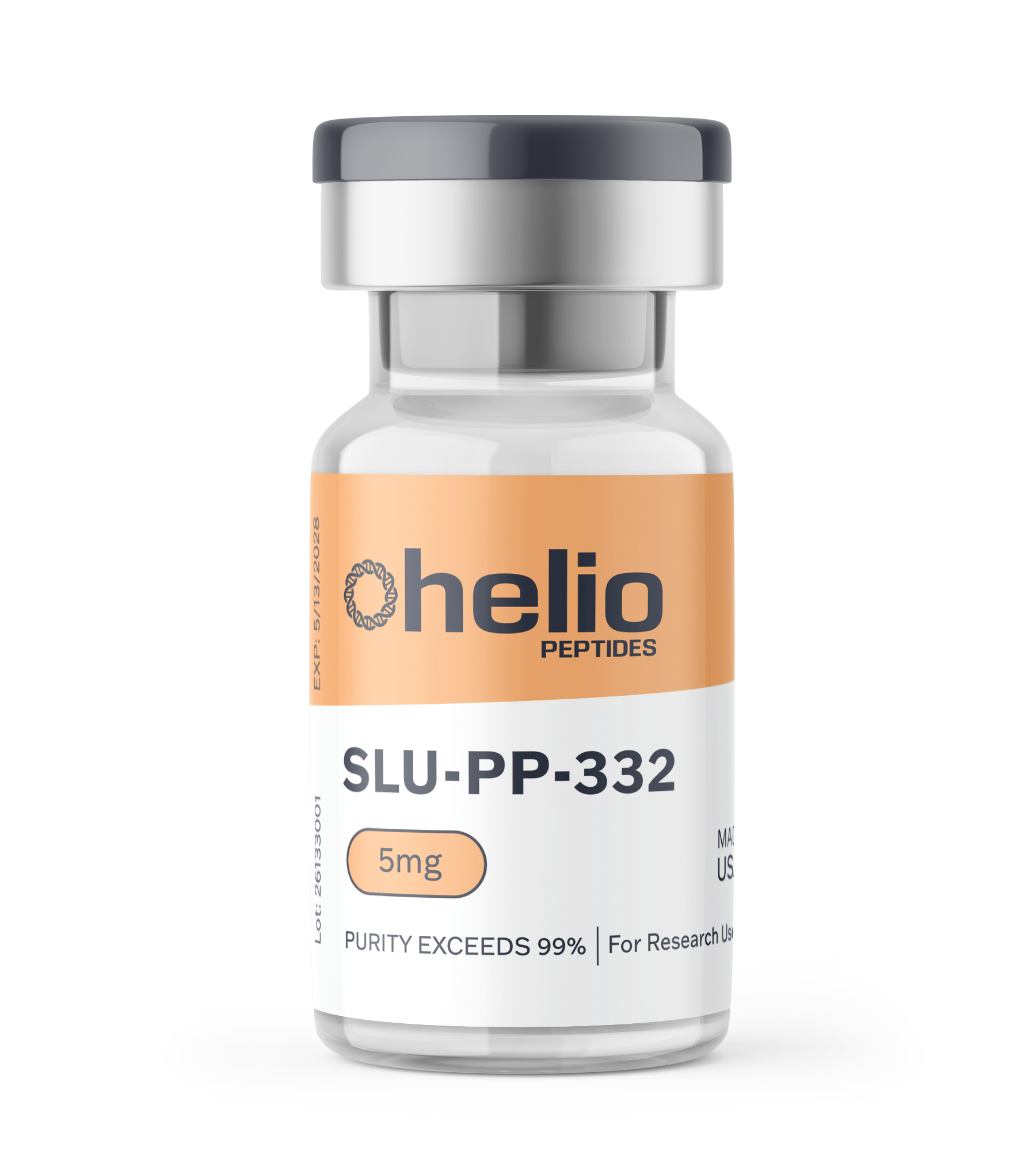
SLU-PP-332 is a small-molecule pan-agonist of the estrogen-related receptors (ERRα, ERRβ, ERRγ), not a peptide. Chemically it is the acylhydrazone 4-hydroxy-N'-(naphthalen-2-ylmethylene)benzohydrazide (IUPAC: 4-hydroxy-N-[(Z)-naphthalen-2-ylmethylideneamino]benzamide), with formula C18H14N2O2, molecular weight 290.32 g/mol, CAS 303760-60-3, and PubChem CID 5404083. It activates all three ERR isoforms with reported EC50 values of approximately 98 nM (ERRα), 230 nM (ERRβ), and 430 nM (ERRγ), making it a preferential ERRα agonist within a pan-ERR profile.
SLU-PP-332 was developed at Saint Louis University as a structural optimization of the earlier ERR agonist GSK4716, in which a naphthalene ring replaced the isopropylphenyl group to substantially increase ERRα potency. Because ERRs are master regulators of mitochondrial biogenesis and oxidative metabolism, SLU-PP-332 has been widely studied as an "exercise mimetic" research tool. It is supplied here strictly as SLU-PP-332 research material for laboratory use.
Research use only — not for human or animal consumption. Per-batch documentation is provided with the material.
SLU-PP-332 has been investigated in experimental and preclinical settings as a pan-ERR agonist that engages the estrogen-related receptor family to drive oxidative-metabolism gene programs. Studies report that, in rodent models of metabolic syndrome, the compound increases energy expenditure and fatty acid oxidation, decreases fat mass, and improves insulin sensitivity, with mechanisms attributed to enhanced mitochondrial biogenesis.
Because ERR activation overlaps with transcriptional adaptations to exercise, SLU-PP-332 has been characterized in the literature as an "exercise mimetic" tool compound and studied in cardiac-metabolism and endurance-adaptation contexts. All described observations derive from preclinical, experimental, or in-vitro models and are presented for research context only.
SLU-PP-332 was developed at Saint Louis University School of Medicine by the laboratory of Thomas Burris as a structural optimization of the ERR agonist GSK4716. Replacing GSK4716's isopropylphenyl group with a naphthalene ring increased ERRα potency roughly 50-fold, yielding a pan-ERR agonist that has since been characterized across multiple peer-reviewed studies of metabolic syndrome, mitochondrial biogenesis, and exercise-adaptation pathways.
View compound profile on NIH PubChem →
Cited literature refers to laboratory and preclinical research. SLU-PP-332 is supplied strictly for research use only and is not intended to diagnose, treat, cure, or prevent any disease.