

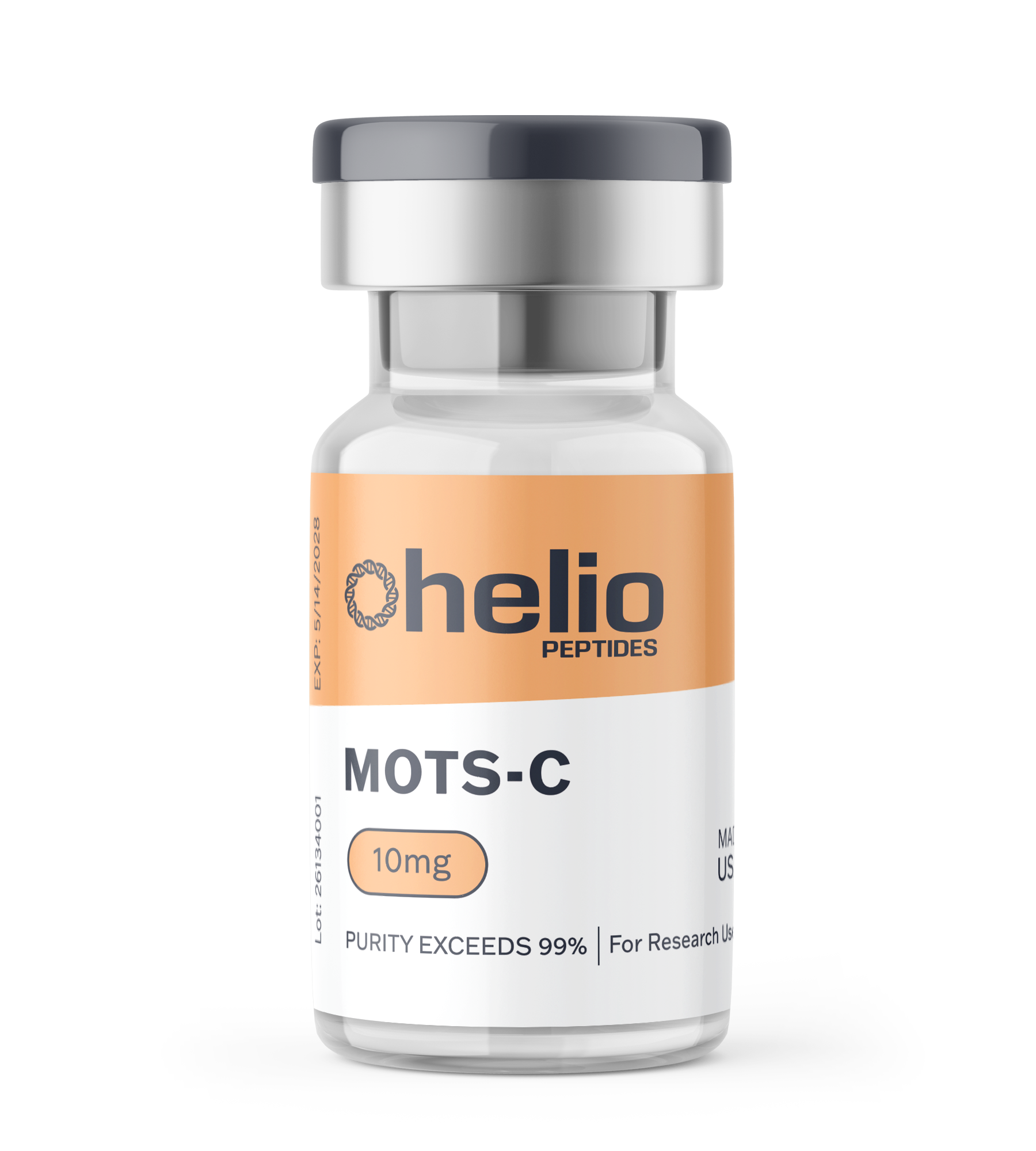
MOTS-c (Mitochondrial Open reading frame of the Twelve S rRNA type-c) is a 16-amino-acid mitochondrial-derived peptide (MDP) encoded within the MT-RNR1 / 12S ribosomal RNA gene of the human mitochondrial genome. Its sequence is MRWQEMGYIFYPRKLR, with CAS 1627580-64-6, molecular formula C101H163N33O24, and a molecular weight of approximately 2174.62 g/mol. As one of a small class of peptides encoded by the mitochondrial rather than the nuclear genome, MOTS-c is studied as a signaling molecule capable of coordinating systemic metabolic responses independent of nuclear gene expression.
MOTS-c was discovered in 2015 and has since become a central molecule in mitochondrial and metabolic biology research. Published studies characterize it as an activator of the AMPK pathway that translocates to the nucleus under metabolic stress to regulate adaptive gene expression. It is offered here solely as MOTS-c research peptide material for laboratory investigation.
MRWQEMGYIFYPRKLR
Research use only — not for human or animal consumption. Per-batch documentation is provided with the material.
MOTS-c has been investigated in experimental and in-vitro settings as a regulator of cellular energy metabolism. Published research reports that it activates the AMPK pathway and influences the folate–AICAR–AMPK axis, with preclinical studies in rodent and cell models examining insulin sensitivity, glucose uptake, and fatty acid oxidation under metabolic stress.
Additional work has characterized MOTS-c as an exercise-induced peptide that translocates to the nucleus to regulate stress-adaptive gene expression, and it has been studied in the context of aging metabolic homeostasis and physical capacity. All described observations derive from preclinical, experimental, or in-vitro models and are presented for research context only.
MOTS-c was identified in 2015 by Changhan David Lee, Pinchas Cohen, and colleagues at the University of Southern California, who described it as a mitochondrial-derived peptide encoded within the 12S rRNA region of the mitochondrial genome that regulates insulin sensitivity and metabolic homeostasis. Subsequent studies expanded its characterization as an AMPK-activating, exercise-associated regulator, establishing it as a widely studied model peptide in mitochondrial biology.
Cited literature refers to laboratory and preclinical research. MOTS-c is supplied strictly for research use only and is not intended to diagnose, treat, cure, or prevent any disease.