
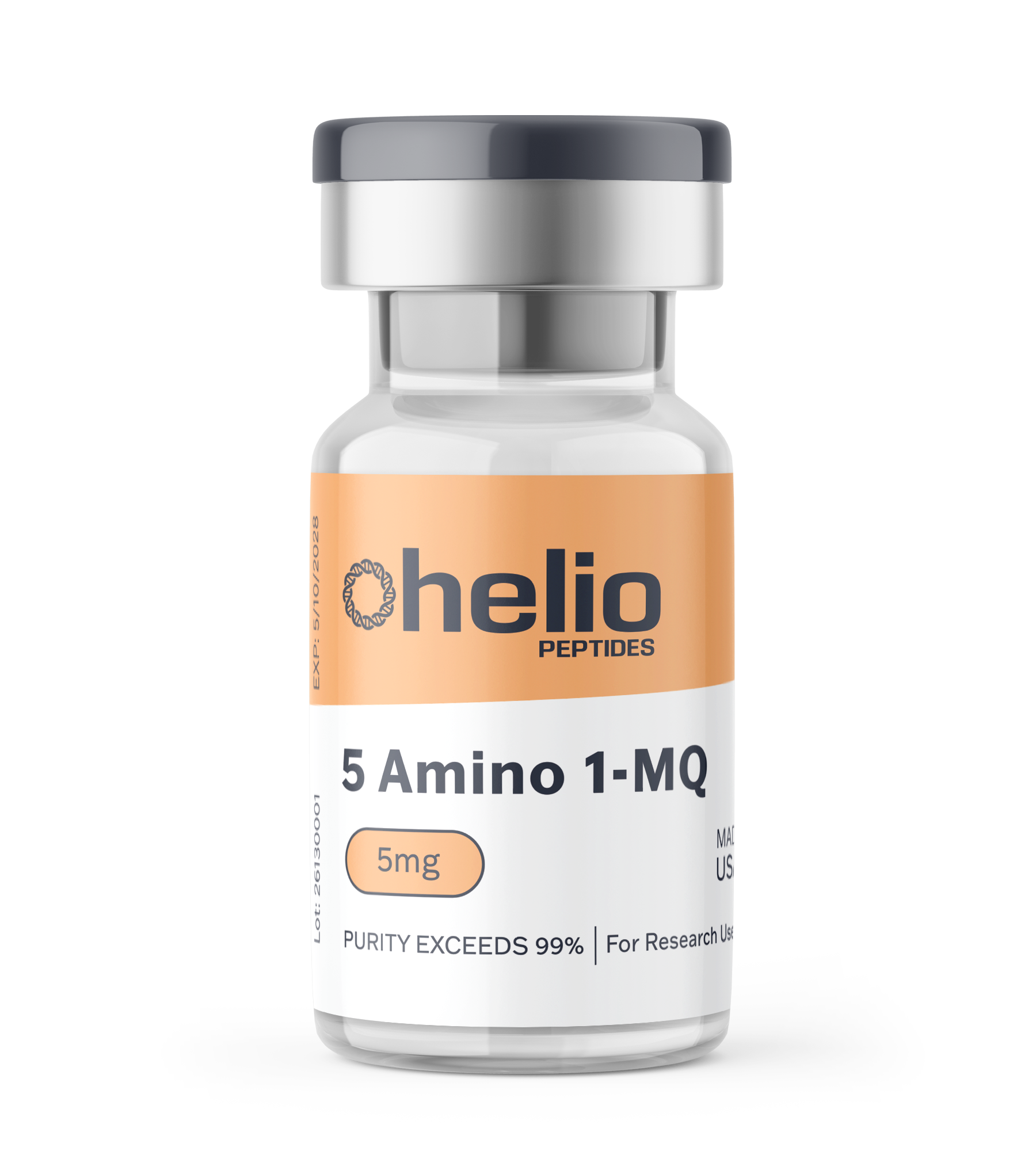
5-Amino-1MQ (5-amino-1-methylquinolinium) is a small-molecule inhibitor of nicotinamide N-methyltransferase (NNMT), not a peptide. Structurally it is a quinolinium scaffold bearing a primary amine at the 5-position and a permanent positive charge introduced by N1-methylation; it is most commonly supplied and studied as the iodide salt (CAS 42464-96-0, C10H11IN2, 286.11 g/mol), while the active cation corresponds to C10H11N2+ (PubChem CID 950107). NNMT catalyzes the S-adenosyl-L-methionine (SAM)-dependent methylation of nicotinamide to 1-methylnicotinamide, a reaction positioned at the intersection of methyl-donor balance and NAD+ salvage. 5-Amino-1MQ occupies the enzyme active site and slows this methylation step in experimental systems.
The compound emerged from medicinal-chemistry programs seeking selective, cell-permeable NNMT inhibitors as tools for adipose and skeletal-muscle metabolism research. In preclinical and in-vitro reports, 5-Amino-1MQ research material has been used to interrogate how NNMT activity influences cellular NAD+ pools, adipocyte lipogenesis, energy expenditure, and myoblast differentiation. It is offered here strictly as 5-Amino-1MQ research material for laboratory investigation.
Research use only — not for human or animal consumption. Per-batch documentation is provided with the material.
5-Amino-1MQ has been investigated in experimental and in-vitro settings as a selective NNMT inhibitor. Published studies report that inhibiting NNMT with quinolinium-class compounds can shift cellular methyl-donor and NAD+ handling, and preclinical work has examined effects on adipocyte size, lipogenic signaling, and whole-body energy expenditure in rodent models of diet-induced obesity.
Additional research has explored NNMT inhibition in skeletal-muscle contexts, including reports that 5-Amino-1MQ promotes myoblast differentiation in cultured cells and influences the regenerative capacity of aged muscle stem cells. All such findings are drawn from preclinical, experimental, or in-vitro models and are presented for research context only.
5-Amino-1MQ arose from academic and industry medicinal-chemistry efforts to develop cell-permeable small-molecule NNMT inhibitors, with quinoline-derived scaffolds described in patent literature and peer-reviewed studies from the mid-2010s onward. Interest in NNMT as a metabolic target grew after the enzyme was linked to adipose-tissue energy metabolism, positioning 5-Amino-1MQ as a widely used tool compound in metabolic and NAD+ research.
View compound profile on NIH PubChem →
Cited literature refers to laboratory and preclinical research. 5-Amino-1MQ is supplied strictly for research use only and is not intended to diagnose, treat, cure, or prevent any disease.