
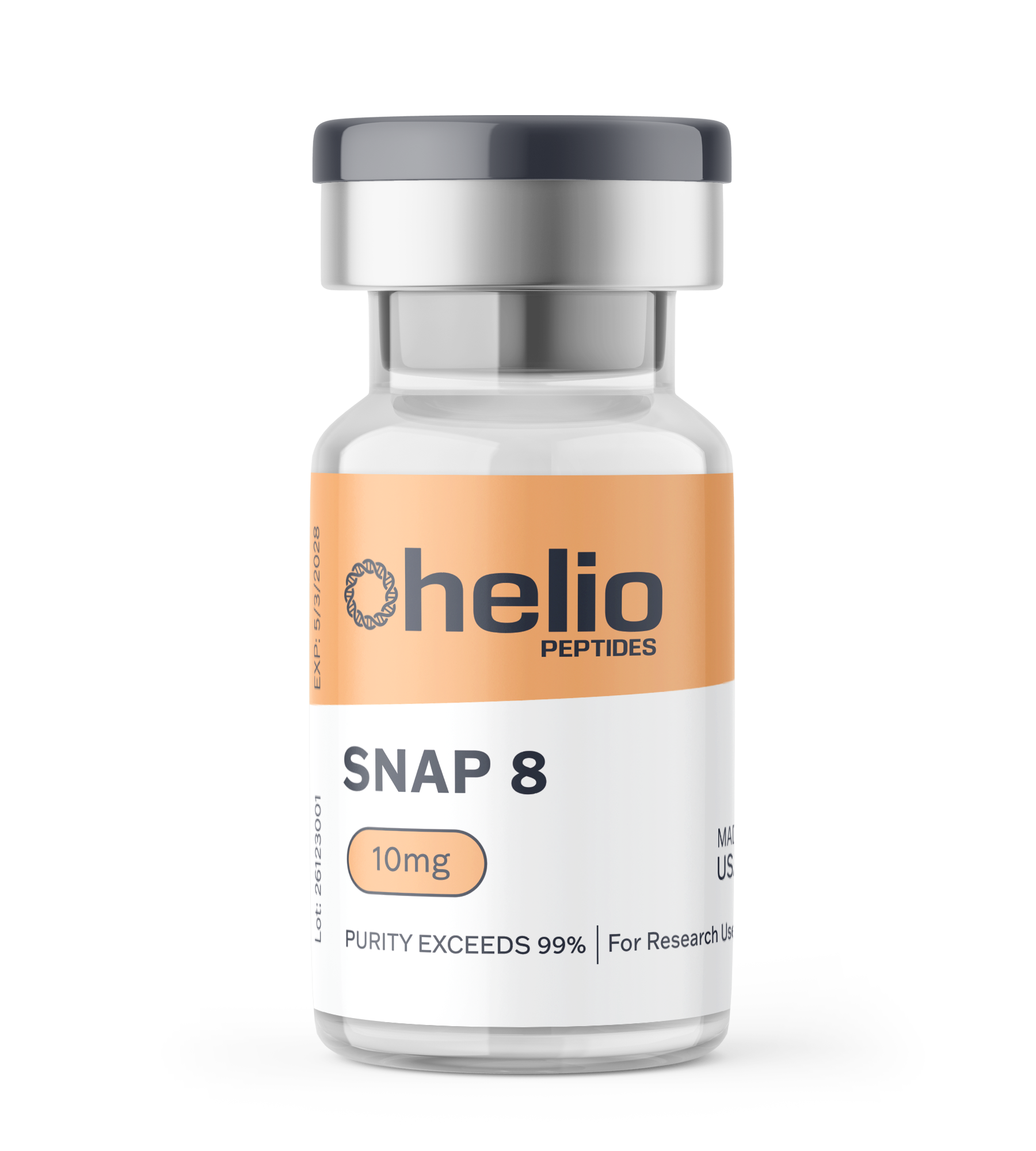
Snap-8, known by the INCI designation Acetyl Octapeptide-3, is an eight-amino-acid synthetic peptide (Ac-Glu-Glu-Met-Gln-Arg-Arg-Ala-Asp-NH2) developed as a structurally extended analog of Acetyl Hexapeptide-8 (Argireline). It is catalogued under CAS 868844-74-0 and PubChem CID 76283482. The sequence corresponds to the N-terminal region of SNAP-25 and is studied as a competitive analog within SNARE-complex formation, the machinery underlying vesicular neurotransmitter release.
Helio's Snap-8 is manufactured by solid-phase peptide synthesis in a US-based facility, with identity confirmed by HPLC and mass spectrometry and third-party testing at an ISO 17025-accredited laboratory; a Certificate of Analysis is available on request. Supplied as a 10mg lyophilized vial, it is intended strictly for in vitro and preclinical Research Use Only and is not for human or veterinary use.
Ac-Glu-Glu-Met-Gln-Arg-Arg-Ala-Asp-NH2 (Ac-EEMQRRAD-NH2)
Research use only — not for human or animal consumption. Per-batch documentation is provided with the material.
Snap-8 is studied as an extended analog of Acetyl Hexapeptide-8 that mimics the N-terminal domain of SNAP-25, a component of the SNARE complex governing vesicle-mediated neurotransmitter release. In vitro research explores whether competitive incorporation of the peptide can attenuate SNARE-complex formation, a mechanism of interest to cosmetic-peptide investigators.
Reported characterization emphasizes its high aqueous solubility and defined eight-residue structure. All work is in vitro or formulation-modeling in nature; no human efficacy or wrinkle-reduction claims are made here.
Snap-8 (Acetyl Octapeptide-3) was introduced in the cosmetic-peptide sector as a next-generation, sequence-extended successor to Acetyl Hexapeptide-8 (Argireline), designed to more closely mimic the SNAP-25 N-terminus for neuromuscular-signaling research.
View compound profile on NIH PubChem →
Cited literature refers to laboratory and preclinical research. Snap-8 (Acetyl Octapeptide-3) is supplied strictly for research use only and is not intended to diagnose, treat, cure, or prevent any disease.