
Research Use Only / Third-Party Analytical Testing / Per-Batch Documentation / Materials Shipped from the USA
GHK-Cu research material
Vial · Research materialHelio®
Skin & Cosmetic Research

GHK-Cu

GHK-Cu, also designated Copper Tripeptide-1, is a copper(II)-chelated complex of the naturally occurring tripeptide glycyl-L-histidyl-L-lysine (Gly-His-Lys, GHK). The GHK sequence was first isolated from human plasma, and its high affinity for divalent copper ions gives rise to the blue-tinted 1:1 complex catalogued in PubChem under CID 71587328. In research settings the compound is studied as a model system for copper transport, extracellular-matrix biology, and copper-dependent enzymatic activity.

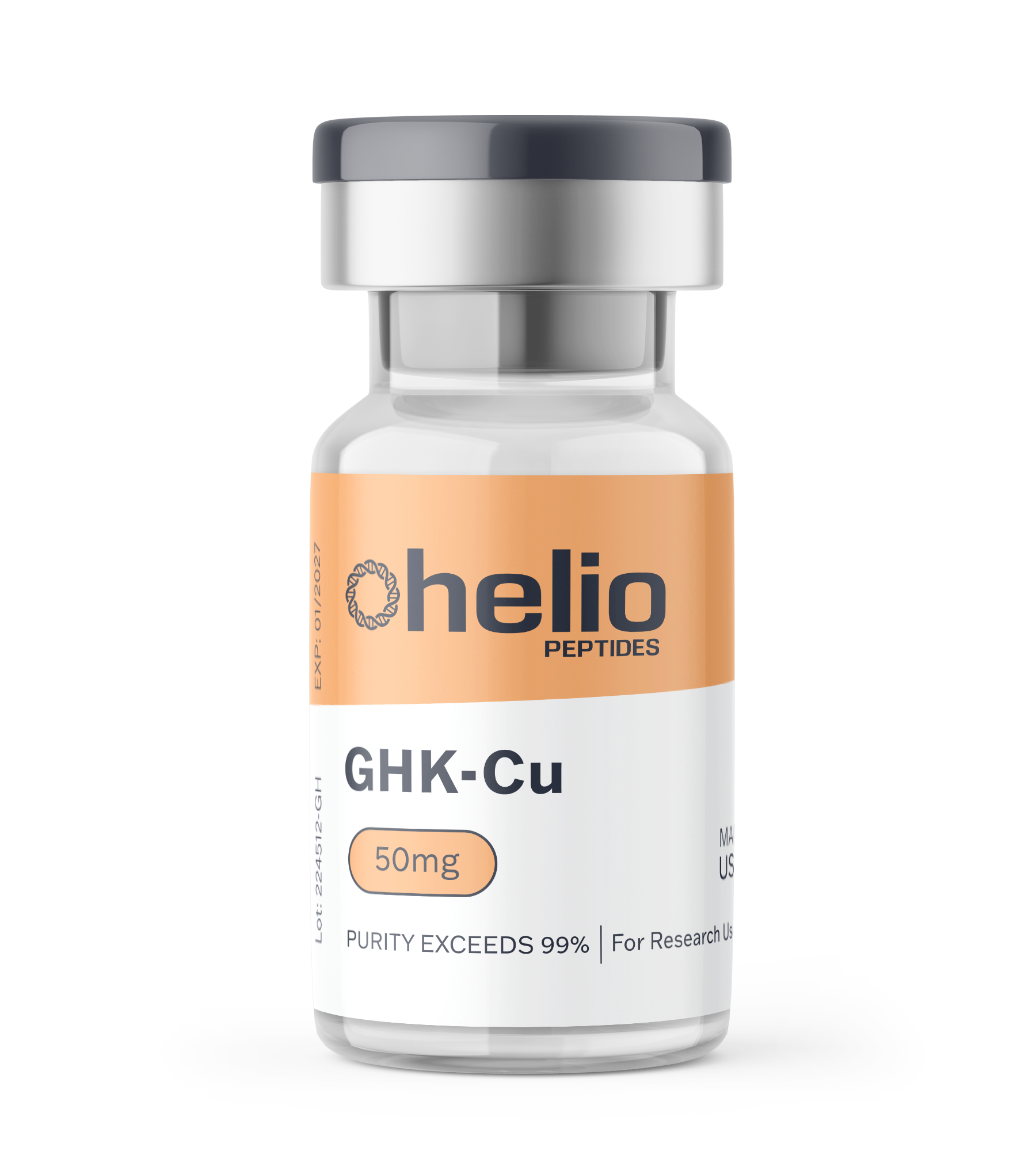
Supplied as a lyophilized powder in a 50mg vial, Helio's GHK-Cu is intended strictly for in vitro and preclinical laboratory investigation. Reported literature explores its interaction with fibroblast cultures, collagen and glycosaminoglycan expression, and copper-signaling pathways. All material is offered for Research Use Only and is not for human or veterinary use.

Identification
  • MaterialGHK-Cu
  • Research AreaSkin & Cosmetic
  • PresentationVial
  • Available Sizes50mg
  • CAS Number89030-95-5
  • Molecular FormulaC14H24CuN6O4
  • Molecular Weight403.92 g/mol
  • TypeCopper-bound tripeptide complex
  • Receptor / TargetCopper-dependent enzymes; matrix and gene-expression modulation (in vitro)
  • PubChem CID71587328 →
Amino Acid Sequence

Gly-His-Lys (copper(II) complex)

Analytical Data
  • Purity (HPLC)≥99%
  • Identity (MS)Confirmed to specification
  • TestingAccredited (ISO 17025) third-party laboratory
  • DocumentationPer-batch COA →
From$29.99

Research use only — not for human or animal consumption. Per-batch documentation is provided with the material.

Key Characteristics
Molecular FormulaC14H24CuN6O4
Molecular Weight403.92 g/mol
CAS Number89030-95-5
PubChem CID71587328
StructureCopper(II) complex of Gly-His-Lys tripeptide
Receptor / TargetCopper-dependent enzymes; ECM and gene-expression modulation (in vitro)
FormLyophilized powder
SolubilitySoluble in water
StorageLyophilized: stable at room temperature short-term; -20°C to -80°C for long-term storage; protect from light
StabilityRefrigerate at 4°C for short-term use; freeze at -80°C for extended storage
Research Context
Extracellular-matrix biologyInvestigated in fibroblast cultures for effects on collagen, elastin, and glycosaminoglycan synthesis.
Copper transport and homeostasisStudied as a small-molecule copper-delivery and chelation model in cell systems.
Gene-expression modulationExplored in transcriptomic studies reporting broad up- and down-regulation patterns in cultured cells.
Wound-healing modelsUsed in preclinical tissue-repair and angiogenesis research paradigms.
Antioxidant enzyme researchExamined in relation to copper-dependent superoxide dismutase and related enzyme activity.
Research Findings

Published in vitro work reports that GHK and its copper complex can influence fibroblast behavior and the expression of extracellular-matrix components such as collagen and glycosaminoglycans. Broad gene-expression profiling studies have described GHK-Cu as modulating large numbers of genes in cultured cells, prompting continued interest as a research tool for tissue-remodeling pathways.

The copper-binding property is central to much of the reported activity, and researchers frequently study GHK-Cu as a defined-stoichiometry model for delivering copper into cellular systems. Findings are preclinical and experimental; no human efficacy conclusions are drawn.

History

The GHK tripeptide was first identified in the 1970s by Loren Pickart as a factor in human plasma, and its strong affinity for copper(II) led to characterization of the GHK-Cu complex. It has since become a widely referenced subject in matrix-biology and copper-signaling research.

References
  1. Pickart L, Margolina A. Regenerative and Protective Actions of the GHK-Cu Peptide in the Light of the New Gene Data. Int J Mol Sci. 2018;19(7):1987.
  2. Pickart L. The human tri-peptide GHK and tissue remodeling. J Biomater Sci Polym Ed. 2008;19(8):969-988.
  3. PubChem Compound Summary for CID 71587328, Copper Peptide GHK-Cu. National Library of Medicine.

View compound profile on NIH PubChem →

Cited literature refers to laboratory and preclinical research. GHK-Cu is supplied strictly for research use only and is not intended to diagnose, treat, cure, or prevent any disease.
Why researchers choose Helio
99%+ PurityHPLC-verified every batch
Accredited TestingIndependent ISO 17025 laboratory
Per-Batch COADocumentation tied to your lot
Made in the USADiscreet, protected shipping
Related

More in Skin & Cosmetic

View area