
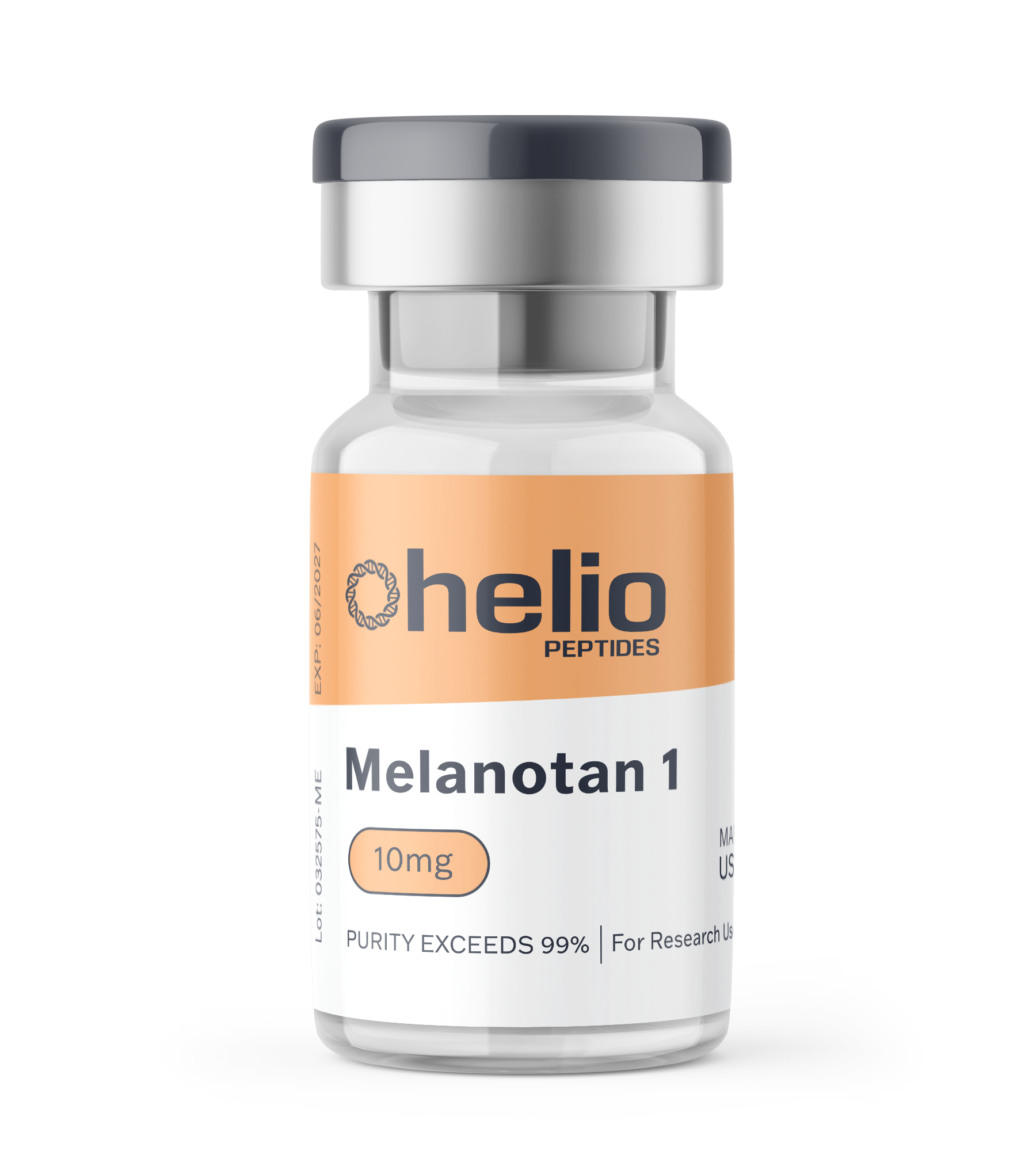
Melanotan I, also known as afamelanotide, is a synthetic linear analog of alpha-melanocyte-stimulating hormone (alpha-MSH). It is a tridecapeptide (13 residues) built on the [Nle4, D-Phe7]-alpha-MSH modification, first synthesized in the search for a more potent and stable melanocortin agonist. It is catalogued under CAS 75921-69-6 and PubChem CID 16197727, and functions as a non-selective melanocortin-receptor agonist with particular activity at MC1R, the receptor governing melanin synthesis.
Supplied as a 10mg lyophilized vial, Helio's Melanotan I is intended strictly for in vitro and preclinical Research Use Only and is not for human or veterinary use. Research applications center on melanocortin-receptor pharmacology and pigmentation-pathway biology.
Ac-Ser-Tyr-Ser-Nle-Glu-His-D-Phe-Arg-Trp-Gly-Lys-Pro-Val-NH2
Research use only — not for human or animal consumption. Per-batch documentation is provided with the material.
Melanotan I (afamelanotide) arose from work identifying [Nle4, D-Phe7]-alpha-MSH as an analog roughly a thousand-fold more potent than native alpha-MSH, owing to substitutions that improve receptor affinity and metabolic stability. It shares the conserved His-Phe-Arg-Trp melanocortin active-site motif and acts primarily through MC1R to drive melanin synthesis in preclinical melanocyte models.
The compound is well characterized in the melanocortin literature and has an established regulatory history as a clinical agent for erythropoietic protoporphyria; however, material offered here is for laboratory research only, with no human efficacy or dosing claims made.
Melanotan was developed in the 1980s by Victor Hruby and colleagues at the University of Arizona, who identified [Nle4, D-Phe7]-alpha-MSH as a highly potent, stable melanocortin agonist later designated Melanotan I and subsequently developed as afamelanotide.
View compound profile on NIH PubChem →
Cited literature refers to laboratory and preclinical research. Melanotan I is supplied strictly for research use only and is not intended to diagnose, treat, cure, or prevent any disease.