
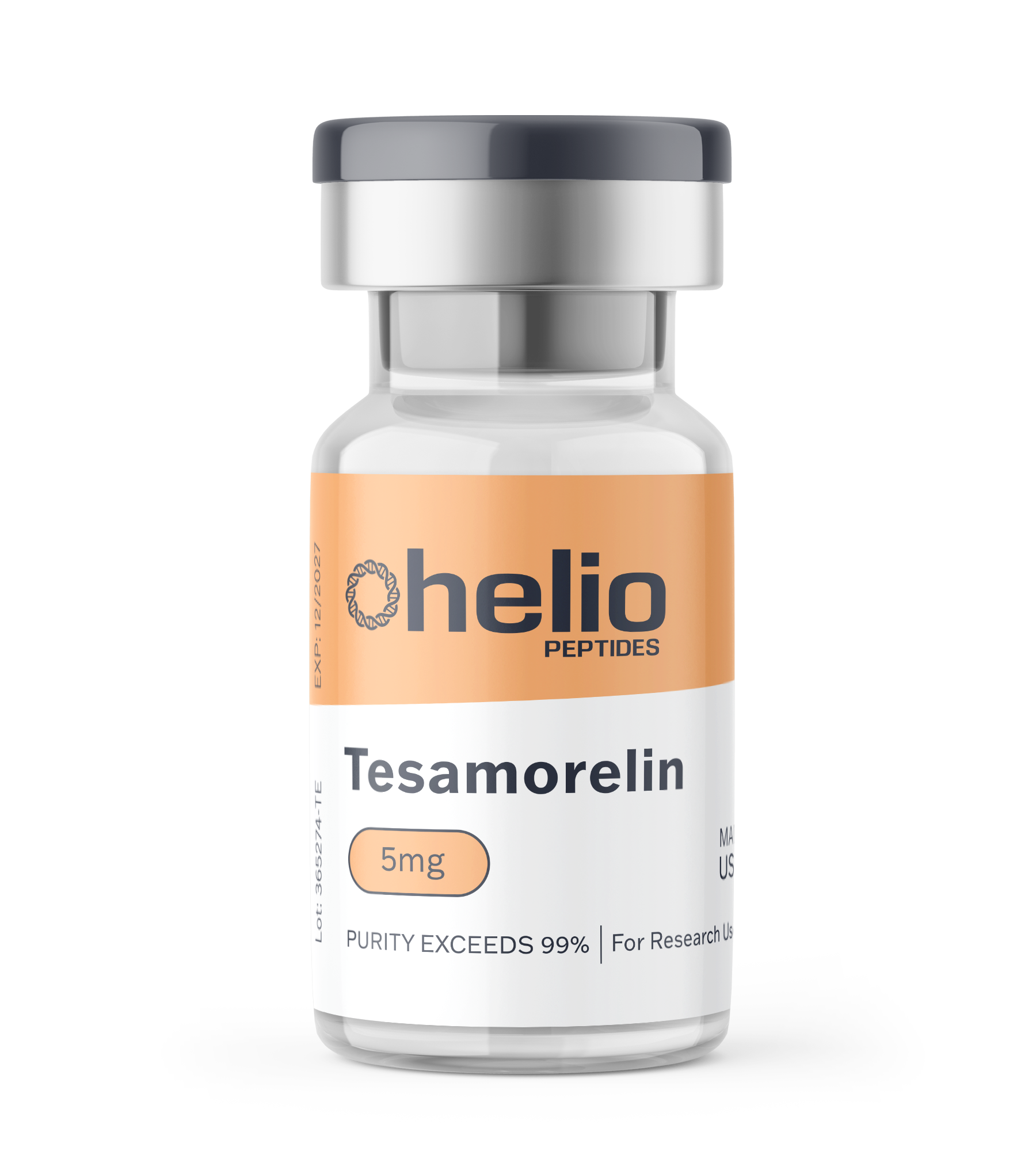
Tesamorelin is a synthetic analog of human growth hormone-releasing factor, GRF(1-44), corresponding to the full-length 44-amino-acid GHRH sequence with a trans-3-hexenoyl group attached to the N-terminal tyrosine. This N-terminal acylation stabilizes the peptide against enzymatic degradation, extending functional activity relative to the unmodified GRF sequence while preserving GHRH-receptor agonism.
In research model systems, Tesamorelin activates the GHRH receptor to stimulate endogenous growth-hormone secretion, and it has been studied extensively for its downstream effects on the GH/IGF-1 axis and on visceral adipose tissue. As a full-length, stabilized GHRH analog, it is often contrasted with the shorter GHRH(1-29)-based tools Sermorelin and CJC-1295 in comparative endocrine research. Supplied as a lyophilized powder for research use only.
trans-3-hexenoyl-Tyr-Ala-Asp-Ala-Ile-Phe-Thr-Asn-Ser-Tyr-Arg-Lys-Val-Leu-Gly-Gln-Leu-Ser-Ala-Arg-Lys-Leu-Leu-Gln-Asp-Ile-Met-Ser-Arg-Gln-Gln-Gly-Glu-Ser-Asn-Gln-Glu-Arg-Gly-Ala-Arg-Ala-Arg-Leu-NH2
Research use only — not for human or animal consumption. Per-batch documentation is provided with the material.
Research on Tesamorelin has characterized it as a stabilized GHRH analog that restores GHRH-receptor-mediated GH secretion and, through the resulting rise in GH and IGF-1, reduces visceral adipose tissue in model systems and clinical study populations. The N-terminal hexenoyl modification is central to its extended activity relative to native GRF.
Studies have also examined its effects on lipid profiles and glucose homeostasis, positioning Tesamorelin as a well-documented tool for investigating the metabolic consequences of sustained GHRH-receptor stimulation.
Tesamorelin was developed by Theratechnologies as a stabilized GRF(1-44) analog and received U.S. FDA approval in November 2010 for the reduction of excess visceral abdominal fat in HIV-associated lipodystrophy. It remains one of the most thoroughly documented GHRH analogs in the clinical and research literature.
View compound profile on NIH PubChem →
Cited literature refers to laboratory and preclinical research. Tesamorelin is supplied strictly for research use only and is not intended to diagnose, treat, cure, or prevent any disease.