Ipamorelin
Research Material
- AreaGrowth Hormone
- CAS170851-70-4
- Purity≥99%
from$39.95
View Material →

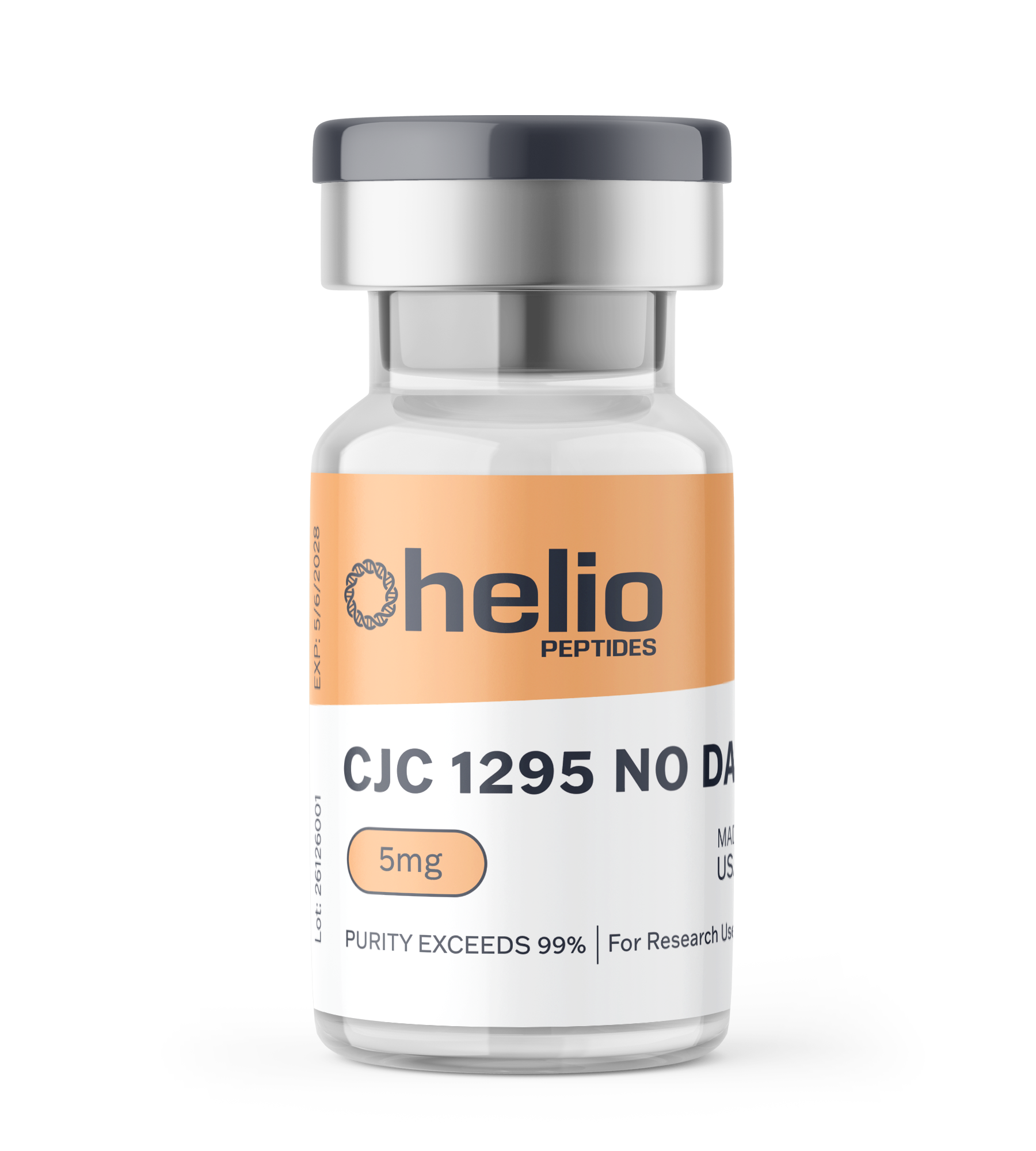
CJC-1295 is a synthetic 29-amino-acid analog of growth hormone-releasing hormone (GHRH), based on the biologically active GHRH(1-29) fragment. The peptide incorporates four amino-acid substitutions (positions 2, 8, 15 and 27) engineered to increase resistance to enzymatic degradation, most notably cleavage by dipeptidyl peptidase-IV (DPP-IV). This substituted backbone is the same core sequence marketed in research contexts as "Modified GRF (1-29)." In laboratory model systems it is studied as a tool for probing GHRH-receptor signaling and pulsatile growth-hormone release from the anterior pituitary.
Two forms circulate in research use. The "No DAC" form (Mod GRF 1-29) is the unconjugated peptide with a short plasma half-life, used to model discrete, transient GHRH pulses. The "With DAC" form appends a Drug Affinity Complex (DAC) moiety that binds serum albumin, substantially extending circulating half-life and enabling investigation of sustained GHRH-receptor exposure. The identity data listed here correspond to the No DAC (Mod GRF 1-29) backbone; the DAC form carries an additional lysine-linked maleimidopropionic acid conjugate and a correspondingly higher molecular weight. All material is supplied for laboratory research only.
Tyr-D-Ala-Asp-Ala-Ile-Phe-Thr-Gln-Ser-Tyr-Arg-Lys-Val-Leu-Ala-Gln-Leu-Ser-Ala-Arg-Lys-Leu-Leu-Gln-Asp-Ile-Leu-Ser-Arg-NH2
Research use only — not for human or animal consumption. Per-batch documentation is provided with the material.
Published research on the CJC-1295 backbone has focused on the pharmacokinetic consequences of DPP-IV-resistant substitutions and albumin conjugation. Studies of the DAC-conjugated form report markedly prolonged circulating half-life relative to native GHRH, with sustained elevation of GH and IGF-1 in animal and early clinical model systems, whereas the unconjugated Mod GRF (1-29) form is characterized by rapid clearance and short, discrete secretory responses.
Comparative work in the GHRH-analog class has examined how conjugation strategy influences the amplitude and pattern of GH pulses, making CJC-1295 a frequently cited experimental system for distinguishing sustained-exposure from pulsatile GHRH-receptor stimulation.
CJC-1295 was developed in the early 2000s by ConjuChem Biotechnologies as part of a program applying Drug Affinity Complex technology to peptide hormones, extending GHRH(1-29) half-life by covalent conjugation to circulating albumin. The unconjugated substituted backbone (Modified GRF 1-29) subsequently became a widely used short-acting research counterpart, and both forms remain common reference tools in growth-hormone-axis studies.
View compound profile on NIH PubChem →
Cited literature refers to laboratory and preclinical research. CJC-1295 is supplied strictly for research use only and is not intended to diagnose, treat, cure, or prevent any disease.