
Research Use Only / Third-Party Analytical Testing / Per-Batch Documentation / Materials Shipped from the USA
Semax research material
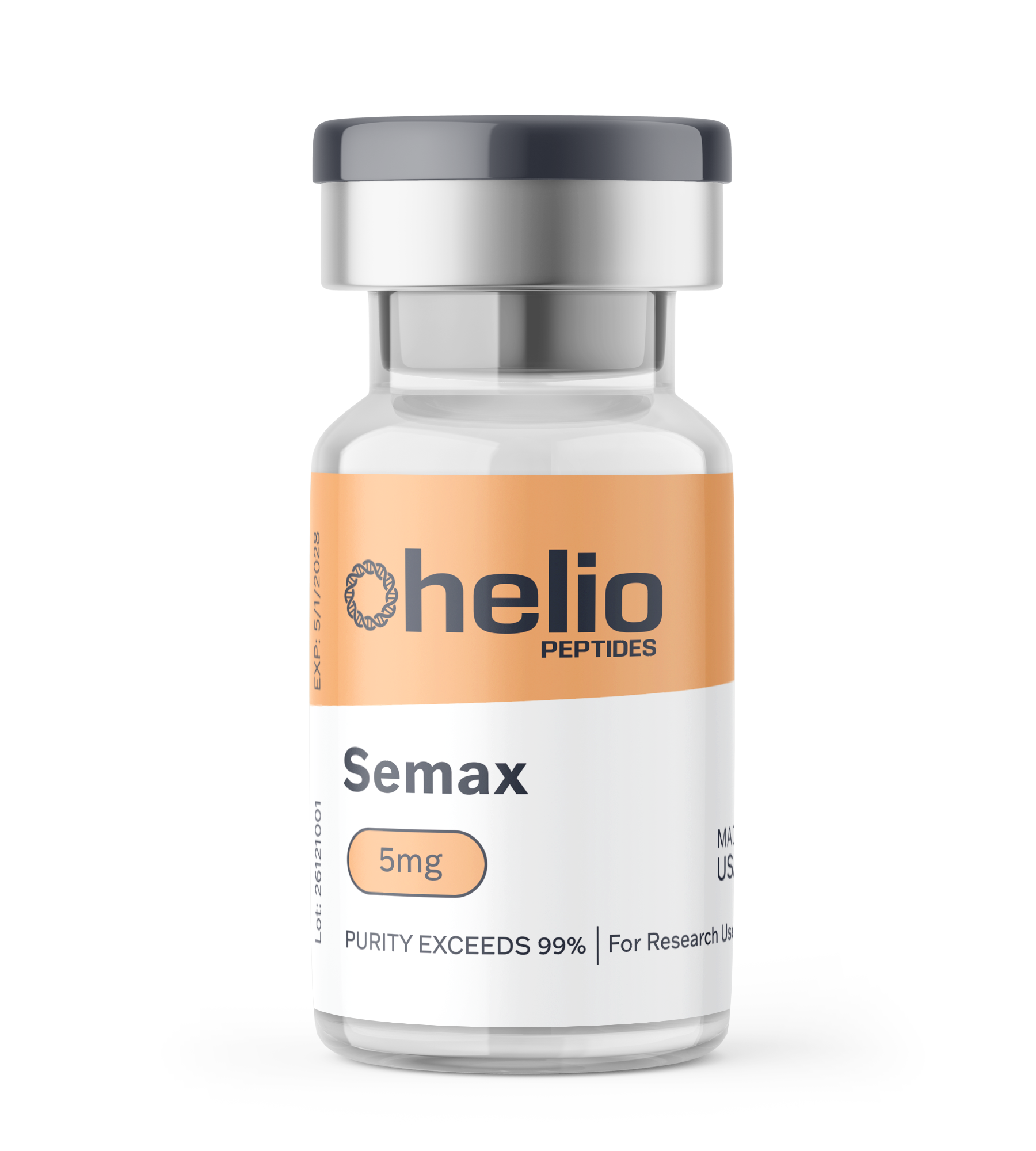
Vial · Research materialHelio®
Cognitive Research

Semax

Semax is a synthetic heptapeptide (Met-Glu-His-Phe-Pro-Gly-Pro) derived from the 4-7 fragment of adrenocorticotropic hormone (ACTH), extended at the C-terminus with a Pro-Gly-Pro sequence to confer resistance to enzymatic degradation. Originally developed at the Institute of Molecular Genetics of the Russian Academy of Sciences, it belongs to the class of regulatory ACTH-derived neuropeptides that are devoid of the corticotropic (hormonal) activity of the parent molecule while retaining central-nervous-system effects. Semax is catalogued in PubChem under CID 9811102 and CAS 80714-61-0.

In the experimental literature, Semax has been investigated primarily as a nootropic and neuroprotective agent. Reported mechanisms in rodent models center on up-regulation of brain-derived neurotrophic factor (BDNF) and nerve growth factor (NGF) with concurrent activation of TrkB/TrkA signaling in the hippocampus. Additional studies describe modulation of dopaminergic and serotonergic systems and effects in models of cerebral ischemia. This material is offered strictly for in-vitro and laboratory research and is not intended for human or animal use.

Identification
  • MaterialSemax
  • Research AreaCognitive
  • PresentationVial
  • Available Sizes5mg
  • CAS Number80714-61-0
  • Molecular FormulaC37H51N9O10S
  • Molecular Weight813.9 g/mol
  • TypeSynthetic heptapeptide
  • Receptor / TargetMelanocortin / BDNF-TrkB neurotrophin signaling (proposed)
  • PubChem CID9811102 →
Amino Acid Sequence

Met-Glu-His-Phe-Pro-Gly-Pro

Analytical Data
  • Purity (HPLC)≥99%
  • Identity (MS)Confirmed to specification
  • TestingAccredited (ISO 17025) third-party laboratory
  • CertificateView COA · Lot 26121001 →
From$29.95

Research use only — not for human or animal consumption. Per-batch documentation is provided with the material.

Key Characteristics
Molecular FormulaC37H51N9O10S
Molecular Weight813.9 g/mol
CAS Number80714-61-0
PubChem CID9811102
StructureSynthetic heptapeptide, ACTH(4-7) analog with C-terminal Pro-Gly-Pro
Receptor / TargetMelanocortin system; BDNF/NGF-TrkB neurotrophin signaling (proposed)
FormLyophilized powder (5mg vial)
SolubilitySoluble in water and bacteriostatic water
StorageLyophilized: -20°C to -80°C for long-term; keep cold and protected from light
StabilityLyophilized powder stable at room temperature for weeks; reconstituted solution refrigerated at 2-8°C
Research Context
Neurotrophin regulationStudied for its capacity to increase BDNF and NGF expression and downstream TrkB/TrkA phosphorylation in rodent hippocampal tissue.
NeuroprotectionInvestigated in experimental models of cerebral ischemia and oxidative stress for potential protective effects on neuronal tissue.
Cognition and learningExamined in animal learning-and-memory paradigms as a representative ACTH-derived nootropic neuropeptide.
Monoaminergic modulationReported in rodent studies to influence central dopaminergic and serotonergic system activity.
Peptide stability researchServes as a model for how C-terminal Pro-Gly-Pro extension confers peptidase resistance to short regulatory peptides.
Research Findings

Published rodent research reports that a single administration of Semax increased hippocampal BDNF protein and exon-III BDNF mRNA levels alongside elevated TrkB tyrosine phosphorylation, identifying the neurotrophin pathway as its most consistently described molecular correlate. Further studies describe activation of central dopaminergic and serotonergic systems and neuroprotective effects in cerebral-ischemia models.

These observations derive from in-vitro systems and animal models and characterize the compound's biochemical behavior in research settings. They do not constitute evidence of clinical efficacy or safety in humans.

History

Semax was developed in the 1980s-1990s at the Institute of Molecular Genetics of the Russian Academy of Sciences as a metabolically stabilized analog of the ACTH(4-10) fragment, engineered to retain neurotropic activity while eliminating the hormonal actions of full-length ACTH. It has since become a widely referenced tool compound in the neuropeptide literature.

References
  1. Dolotov OV, et al. Semax, an analog of ACTH(4-10) with cognitive effects, regulates BDNF and trkB expression in the rat hippocampus. Brain Research. 2006;1117(1):54-60.
  2. Eremin KO, et al. Semax, an ACTH(4-10) analogue with nootropic properties, activates dopaminergic and serotoninergic brain systems in rodents. Neurochemical Research. 2005;30(12):1493-1500.
  3. Tsai SJ. Semax, an analogue of adrenocorticotropin (4-10), is a potential agent for the treatment of attention-deficit hyperactivity disorder and Rett syndrome. Medical Hypotheses. 2007;68(5):1144-1146.
  4. PubChem Compound Summary for CID 9811102, Semax. National Center for Biotechnology Information.

View compound profile on NIH PubChem →

Cited literature refers to laboratory and preclinical research. Semax is supplied strictly for research use only and is not intended to diagnose, treat, cure, or prevent any disease.
Why researchers choose Helio
99%+ PurityHPLC-verified every batch
Accredited TestingIndependent ISO 17025 laboratory
Per-Batch COADocumentation tied to your lot
Made in the USADiscreet, protected shipping
Related

More in Cognitive

View area