
Research Use Only / Third-Party Analytical Testing / Per-Batch Documentation / Materials Shipped from the USA
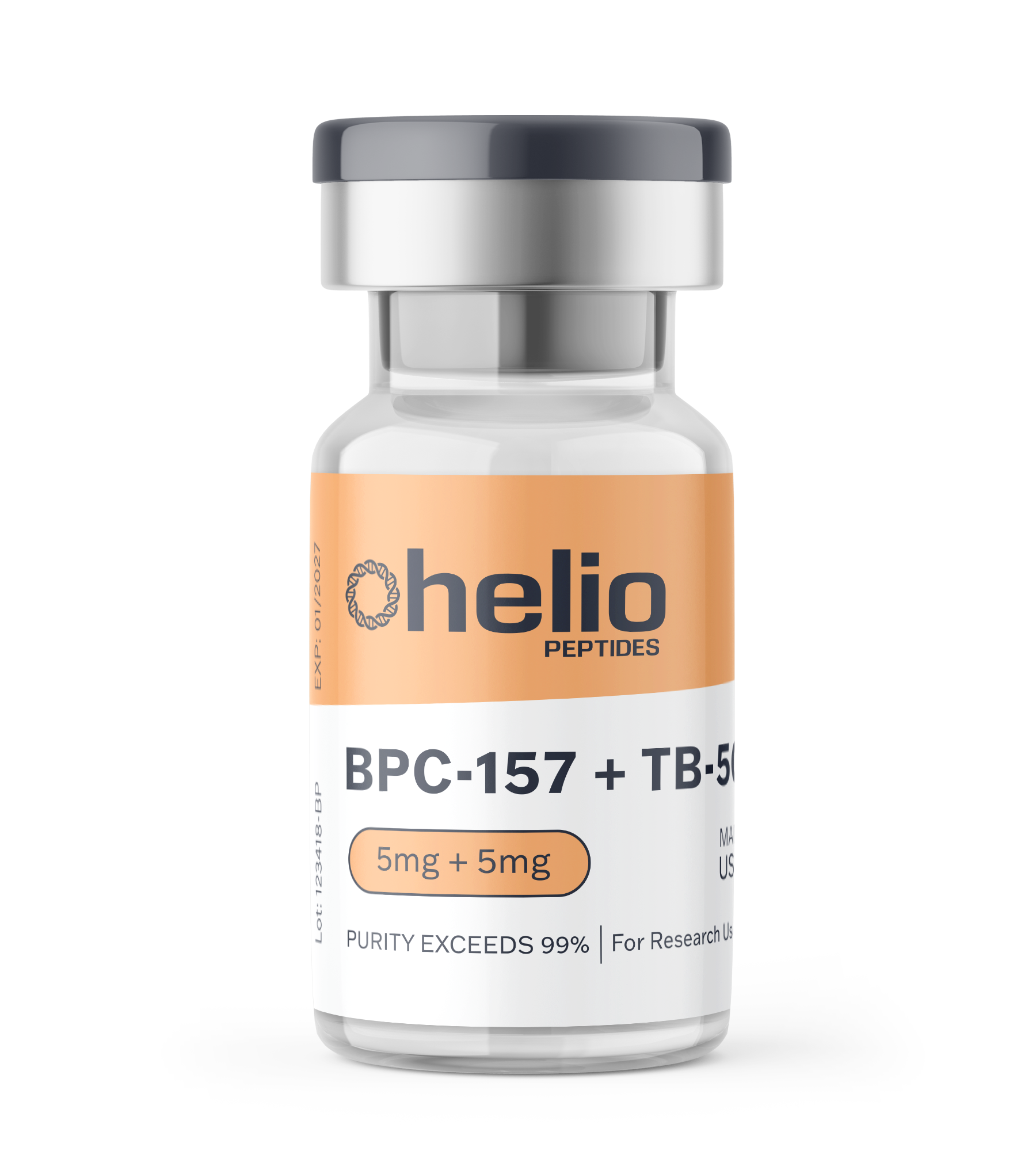
BPC-157 + TB-500 Liquid Spray research material
Liquid Spray · Research materialHelio®
Recovery Research

BPC-157 + TB-500 Liquid Spray

This product delivers the BPC-157 + TB-500 recovery-research pairing in a pre-formulated liquid spray, an intranasal/liquid format that provides a ready-to-use solution without reconstitution. BPC-157 is a synthetic pentadecapeptide (GEPPPGKPADDAGLV; C62H98N16O22; ~1419.5 g/mol; CAS 137525-51-0; PubChem CID 9941957). TB-500 corresponds to full-length Thymosin Beta-4, a 43-residue N-acetylated peptide (C212H350N56O78S; ~4963 g/mol; CAS 77591-33-4; PubChem CID 16132341) whose primary molecular action is sequestration of monomeric G-actin.

The two peptides are combined because their proposed mechanisms are complementary: BPC-157 is associated with angiogenesis and nitric-oxide signaling, while TB-500 is associated with actin-driven cell migration and cytoskeletal remodeling. The liquid spray format supports research handling, delivery and stability studies. This material is Research Use Only and is not for human or veterinary use.

Identification
  • MaterialBPC-157 + TB-500 Liquid Spray
  • Research AreaRecovery
  • PresentationLiquid Spray
  • Available SizesSpray
  • CAS Number137525-51-0 (BPC-157); 77591-33-4 (TB-500 / Thymosin Beta-4)
  • Molecular FormulaC62H98N16O22 (BPC-157); C212H350N56O78S (TB-500)
  • Molecular Weight~1419.5 g/mol (BPC-157); ~4963.44 g/mol (TB-500)
  • TypeBlend of two synthetic peptides in liquid format (pentadecapeptide + 43-residue Thymosin Beta-4)
  • Receptor / TargetBPC-157: VEGFR2 / NO-eNOS-Akt signaling (no defined receptor); TB-500: G-actin sequestration
Amino Acid Sequence

BPC-157: GEPPPGKPADDAGLV (15 aa); TB-500: Ac-SDKPDMAEIEKFDKSKLKKTETQEKNPLPSKETIEQEKQAGES (43 aa)

Analytical Data
  • Purity (HPLC)≥99%
  • Identity (MS)Confirmed to specification
  • TestingAccredited (ISO 17025) third-party laboratory
  • DocumentationPer-batch COA →
From$99.95

Research use only — not for human or animal consumption. Per-batch documentation is provided with the material.

Component Profiles

BPC-157

  • FormulaC62H98N16O22
  • Weight~1419.5 g/mol
  • CAS137525-51-0
  • StructureSynthetic pentadecapeptide (15 aa), GEPPPGKPADDAGLV
  • ReceptorNo defined receptor; VEGFR2 and NO / eNOS-Akt angiogenic signaling

TB-500 (Thymosin Beta-4)

  • FormulaC212H350N56O78S
  • Weight~4963.44 g/mol
  • CAS77591-33-4
  • StructureN-acetylated 43-residue peptide (full-length Thymosin Beta-4)
  • ReceptorMonomeric G-actin (actin sequestration); angiogenic actin-binding motif
Key Characteristics
Molecular FormulaC62H98N16O22 (BPC-157) + C212H350N56O78S (TB-500)
Molecular Weight~1419.5 g/mol (BPC-157); ~4963.44 g/mol (TB-500)
CAS Number137525-51-0 (BPC-157); 77591-33-4 (TB-500)
PubChem CID9941957 (BPC-157); 16132341 (TB-500)
StructureTwo linear synthetic peptides co-formulated in liquid (15 aa + 43 aa)
Receptor / TargetBPC-157: VEGFR2/NO-eNOS-Akt; TB-500: G-actin sequestration
FormLiquid spray (pre-formulated solution)
SolubilityBoth peptides fully solubilized in aqueous carrier
StorageRefrigerate at 4°C and protect from light; avoid heat and repeated temperature cycling
StabilityLiquid format best kept cold and light-protected to preserve peptide integrity
Research Context
AngiogenesisBoth peptides are studied for pro-angiogenic effects via distinct pathways.
Cell migrationTB-500 promotes actin-driven migration of fibroblasts and endothelial cells.
Connective-tissue repairPaired in tendon, ligament and muscle injury research for complementary endpoints.
Mucosal & delivery researchLiquid/intranasal format supports delivery and stability-focused studies.
Nitric oxide signalingBPC-157 contributes NO / eNOS-Akt cytoprotective effects.
Research Findings

The BPC-157 / TB-500 combination is widely used in preclinical recovery research owing to complementary mechanisms, vascular and nitric-oxide signaling from BPC-157 and actin-cytoskeleton regulation from TB-500. Component-level studies (Sikiric et al.; Malinda et al.; Goldstein et al.) report angiogenic and tissue-repair endpoints in animal and in-vitro models, and the liquid format additionally enables delivery and stability research.

No controlled data establish synergy or human efficacy of the blend; co-formulation is for research convenience only. All associated findings are experimental.

History

BPC-157 (derived from gastric-juice Body Protection Compound in the 1990s) and Thymosin Beta-4 (characterized since the 1980s) each carry independent experimental histories; their combination as a liquid research blend reflects shared use in connective-tissue and wound-repair studies. Both remain unapproved investigational compounds for laboratory research only.

References
  1. Sikiric P, Seiwerth S, Rucman R, et al. Stable gastric pentadecapeptide BPC 157: novel therapy in gastrointestinal tract. Current Pharmaceutical Design. 2011;17(16):1612-1632.
  2. Seiwerth S, Brcic L, Vuletic LB, et al. BPC 157 and blood vessels. Current Pharmaceutical Design. 2014;20(7):1121-1125.
  3. Malinda KM, Sidhu GS, Mani H, et al. Thymosin beta4 accelerates wound healing. Journal of Investigative Dermatology. 1999;113(3):364-368.
  4. Philp D, Kleinman HK. Animal studies with thymosin beta4, a multifunctional tissue repair and regeneration peptide. Annals of the New York Academy of Sciences. 2010;1194:81-86.

Cited literature refers to laboratory and preclinical research. BPC-157 + TB-500 Liquid Spray is supplied strictly for research use only and is not intended to diagnose, treat, cure, or prevent any disease.
Why researchers choose Helio
99%+ PurityHPLC-verified every batch
Accredited TestingIndependent ISO 17025 laboratory
Per-Batch COADocumentation tied to your lot
Made in the USADiscreet, protected shipping
Related

More in Recovery

View area