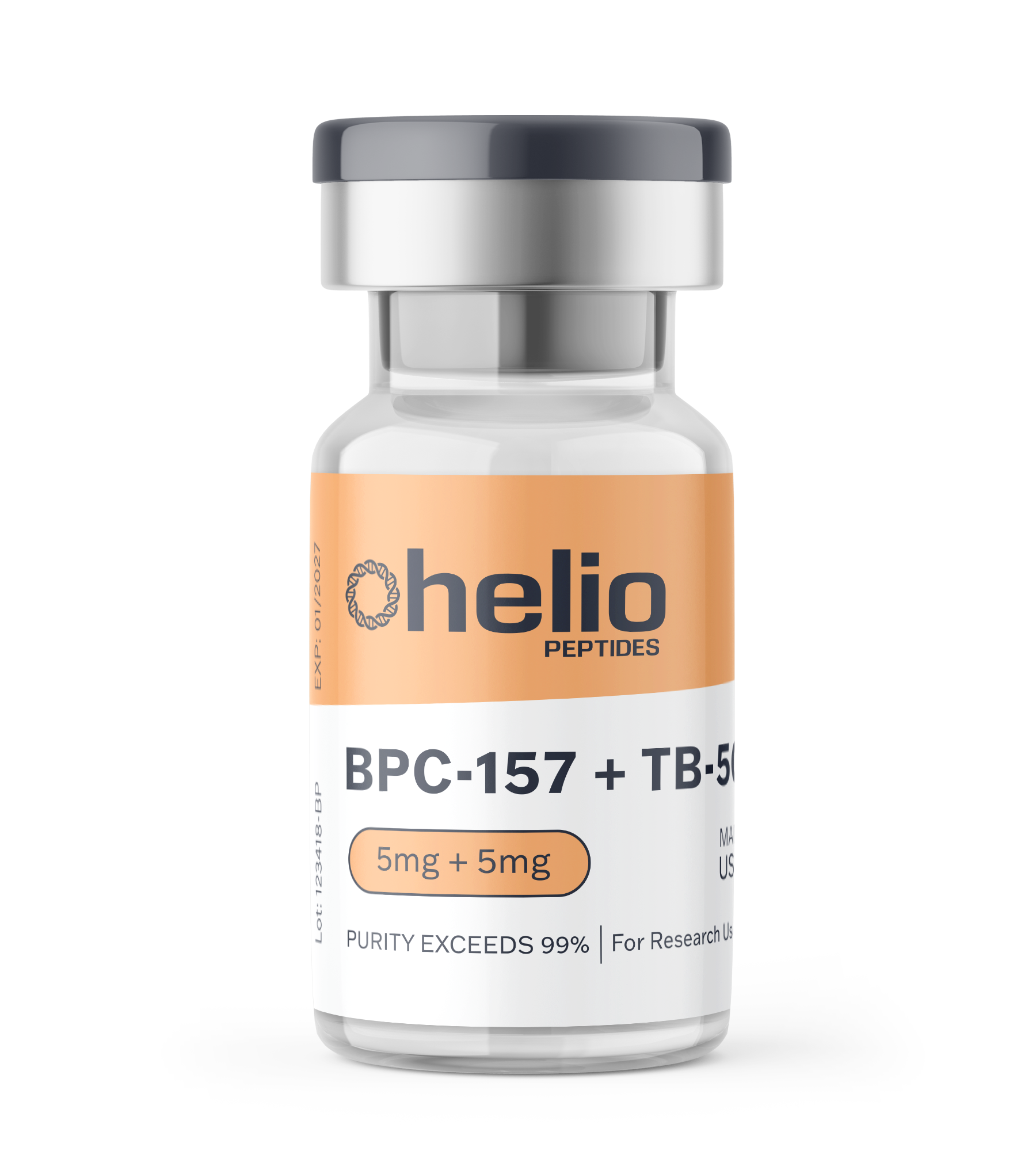

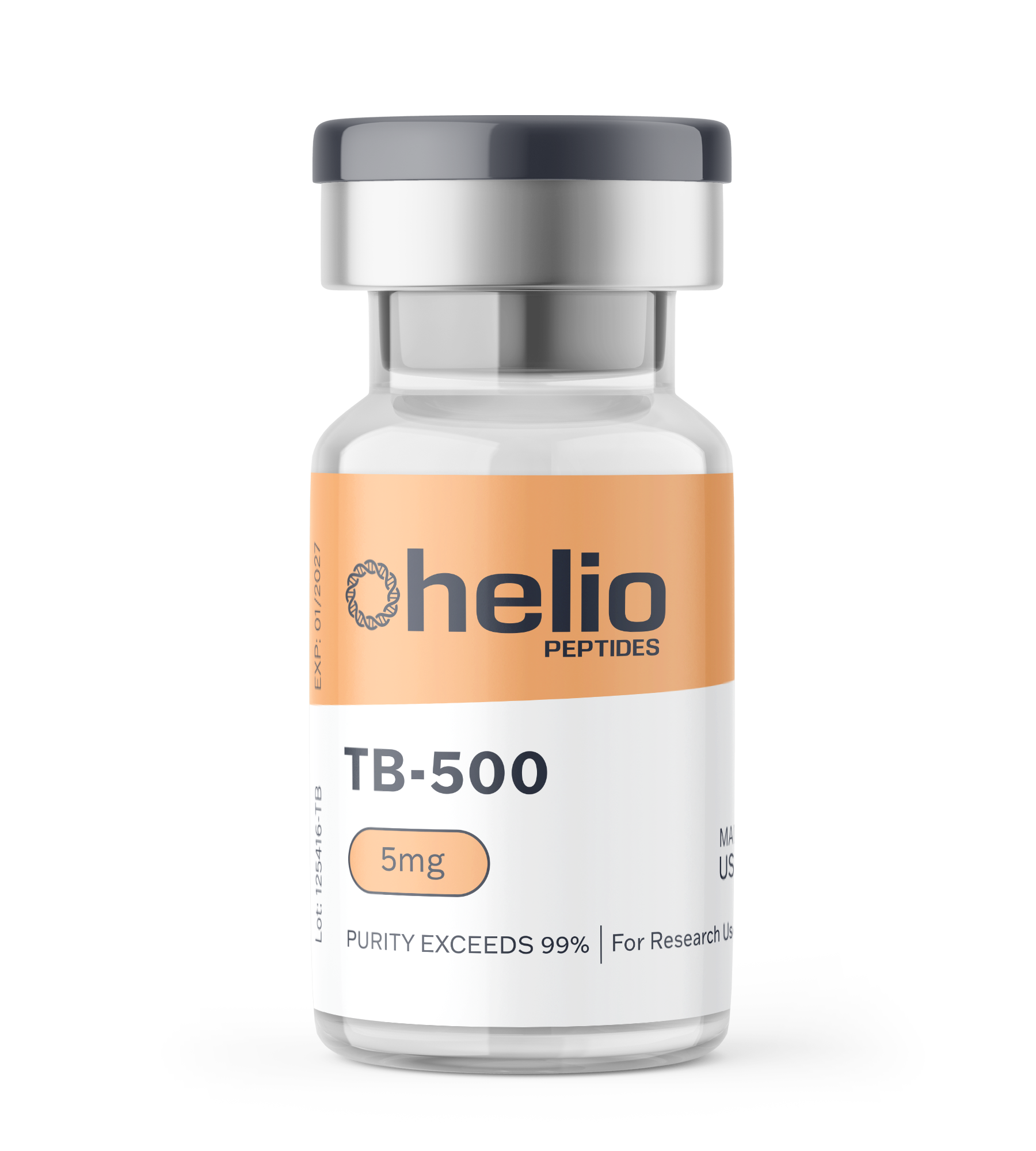
TB-500 is the research designation associated with Thymosin Beta-4 (Tβ4), a naturally occurring 43-amino-acid peptide and the principal G-actin-sequestering molecule in mammalian cells. As commonly supplied, the full-length peptide carries an N-terminal acetyl group and the sequence Ac-SDKPDMAEIEKFDKSKLKKTETQEKNPLPSKETIEQEKQAGES, corresponding to molecular formula C212H350N56O78S, molecular weight approximately 4963 g/mol, CAS 77591-33-4 and PubChem CID 16132341. Note that some literature applies the "TB-500" name to a shorter active fragment; Helio material corresponds to the full-length Thymosin Beta-4 sequence.
Thymosin Beta-4 has been studied for roles in actin regulation, cell migration, angiogenesis and tissue repair. Its seven-residue actin-binding motif has been identified as essential for angiogenic activity. Helio supplies TB-500 as a lyophilized powder in 5 mg vials. This material is offered for Research Use Only and is not intended for human or veterinary use.
Ac-Ser-Asp-Lys-Pro-Asp-Met-Ala-Glu-Ile-Glu-Lys-Phe-Asp-Lys-Ser-Lys-Leu-Lys-Lys-Thr-Glu-Thr-Gln-Glu-Lys-Asn-Pro-Leu-Pro-Ser-Lys-Glu-Thr-Ile-Glu-Gln-Glu-Lys-Gln-Ala-Gly-Glu-Ser-OH (N-acetylated, 43 aa)
Research use only — not for human or animal consumption. Per-batch documentation is provided with the material.
Thymosin Beta-4 is characterized in the literature primarily as an actin-sequestering peptide that "moonlights" as a tissue-repair factor. Studies including Malinda et al. (1999) reported accelerated reepithelialization, angiogenesis and collagen deposition in rodent dermal wound models, while Grant and colleagues demonstrated that the actin-binding site is required for angiogenic activity.
These findings derive from animal and in-vitro experiments and describe an endogenous peptide's biology; controlled human efficacy for the research compound has not been established. Data should be treated as experimental.
Thymosin Beta-4 was originally isolated from thymus tissue and later recognized as the major intracellular actin-sequestering peptide; it has been studied since the 1980s-1990s for actin regulation and wound healing. In the research-peptide market the "TB-500" name became attached to this sequence (and to a related active fragment). It remains an unapproved investigational compound for laboratory research only.
View compound profile on NIH PubChem →
Cited literature refers to laboratory and preclinical research. TB-500 is supplied strictly for research use only and is not intended to diagnose, treat, cure, or prevent any disease.