
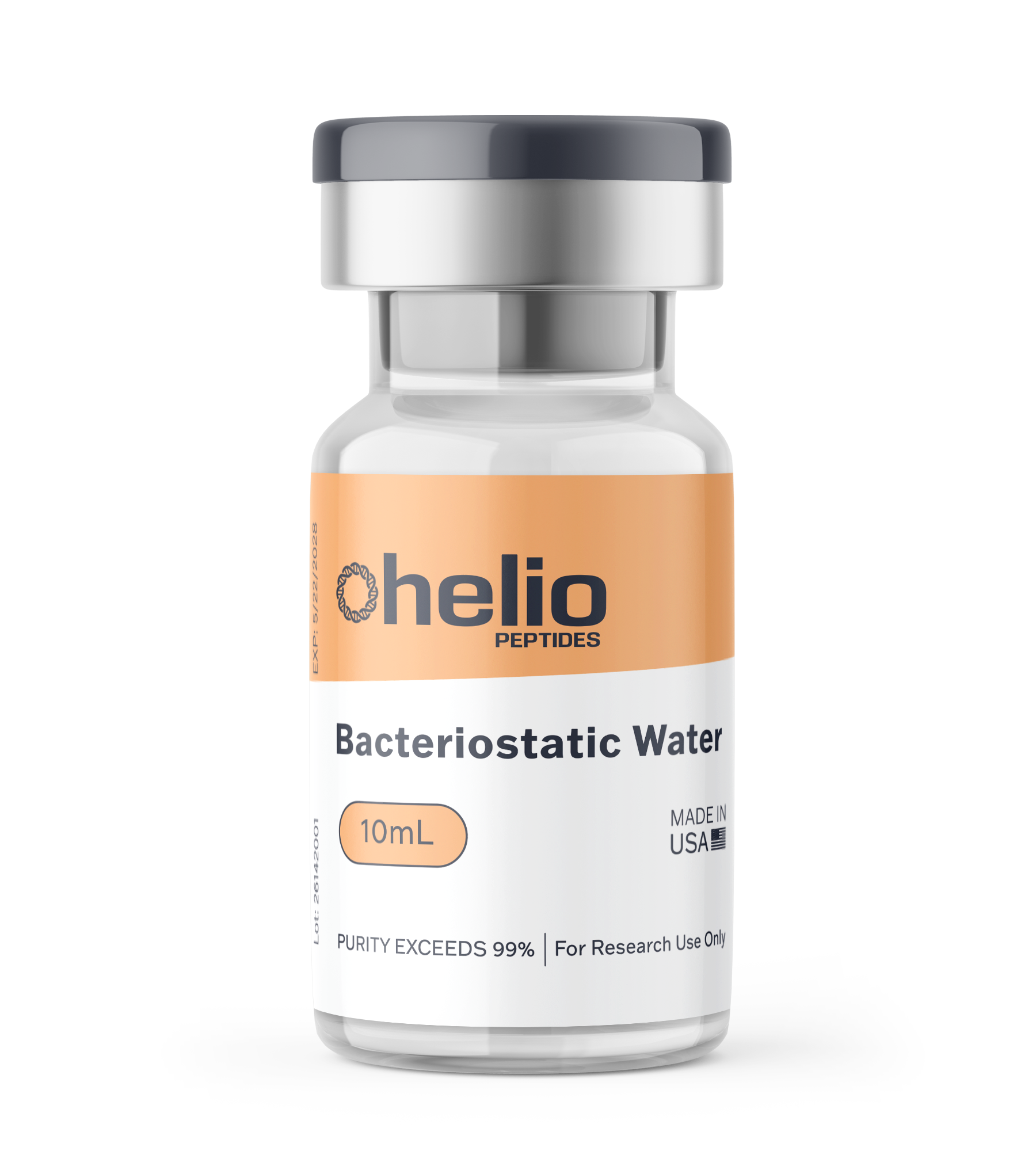
Bacteriostatic Water is a reconstitution solvent, not a peptide or active research compound. It consists of sterile water for injection combined with a bacteriostatic agent, most commonly 0.9% benzyl alcohol, which suppresses the growth of microorganisms and allows the solution to be accessed multiple times over a limited period while reducing contamination risk. It carries no CAS number, molecular formula, or receptor identity because it is a formulated diluent rather than a single defined molecule.
In research workflows, bacteriostatic water is used to dissolve and reconstitute lyophilized (freeze-dried) research materials into a liquid solution for downstream handling. The bacteriostatic property makes it suitable for multi-use scenarios where a reconstituted solution may be drawn from over several days or weeks, in contrast to single-use sterile water. This item is supplied for laboratory research use only and is not intended for human or veterinary use.
Research use only — not for human or animal consumption. Per-batch documentation is provided with the material.
Bacteriostatic water differs from plain sterile water primarily through the inclusion of a bacteriostatic preservative, typically benzyl alcohol, which inhibits microbial proliferation and supports repeated access to a reconstituted vial. It contributes no pharmacological activity of its own; its role is limited to acting as a stable, low-contamination solvent for dissolving lyophilized research materials.
Bacteriostatic water has long been used across laboratory and pharmaceutical settings as a standard diluent for reconstituting freeze-dried compounds, valued for the extended usability that its bacteriostatic preservative provides compared with single-use sterile water.